Skip navigation

>I found www.xtranormal.com the other day and it’s a really fun tool for creating your own animated movies, based only on your typed script. In addition to your script, you can easily add camera movements, gestures, sound effects, etc., in a simple drag-and-drop interface.

http://www.xtranormal.com/site_media/players/jwplayer.swfhttp://www.xtranormal.com/site_media/players/embedded-xnl-stats.swf

I made this little movie, inspired by the current crazy state of the Irish economy and the Irish government’s mismanagement. No politicians were harmed in the making of this movie.

>The Lovely Weather Donegal Artists Residencies, a ground breaking art & science project examines the issues of climate change in County Donegal, Ireland.

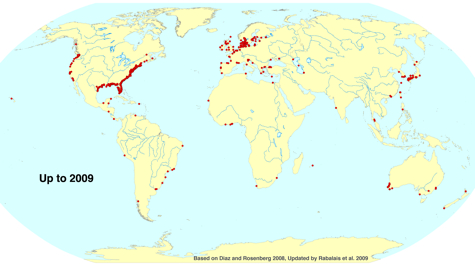
In 2008, Virginia Institute of Marine Science Professor Robert Diaz showed that the number of “dead zones”—areas of seafloor with too little oxygen for most marine life—had increased by a third between 1995 and 2007. Diaz and collaborator Rutger Rosenberg of the University of Gothenburg in Sweden found that dead zones are now “the key stressor on marine ecosystems” and “rank with over-fishing, habitat loss, and harmful algal blooms as global environmental problems.” The study, which appeared in the August 15, 2008 issue of the journal Science, tallied 405 dead zones in coastal waters worldwide, affecting an area of 95,000 square miles, about the size of New Zealand.

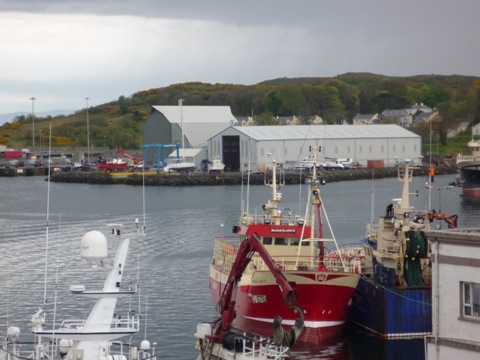
It is currently estimated that there are 20 such ‘dead zones’ in Ireland and two ‘contested dead zones’ were identified in the study at both Killybeg’s Harbour (1999) and Donegal Bay (2000). With a number of unique and purpose designed statistical algorithms and heuristics, Softday (visual artist Sean Taylor and Mikael Fernström)  have translated the scientific/environmental data of the Dead Zones into abstract ‘live’ sound sonifications and vocalisations.
On Saturday the 16th of October 2010, at 19:00, Softday will stage the world premiere of ‘Marbh Chrios (Dead Zone)‘, a live performance of a unique multimedia sound art work, in Mooney’s Boatyard, Killybegs, County Donegal. The computer generated music composition that the Donegal Youth Orchestra and the Softday Céilí Band will perform, is constructed utilising eight years of related marine data. Admission to the event is free, please contact Terre Duffy at the Regional Culture Centre, Letterkenny for further information: terre.duffy@donegalcoco.ie, mobile: 087 2508373

This project was made possible with the support of the Regional Cultural Centre / Donegal County Council Public Art Office in partnership with Leonardo/Olats, Met Éireann, Marine Institute of Ireland, Aquafact International Services Ltd, County Donegal VEC, Donegal Music Education Partnership, Killybegs and District Chamber of Commerce Ltd, the Killybegs Fishermen’s Organisation Ltd, Mooney’s Boatyard, and the Marine & Heritage Centre Killybegs. Further project information from: Softday.

>

Irish Rail have problems and is actively ripping off their customers.

I traveled from Limerick to Maynooth the other day. My colleague had pre-booked and bought his ticket online and had no problem getting his ticket based on his reservation code. His ticket covered Limerick Colbert – Dublin Heuston [Luas tram] Connolly Station – Maynooth.
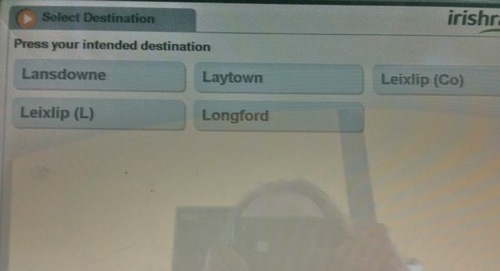
I really don’t trust Irish rail’s pre-booking system as it has failed me in the past, a couple of years ago. Anyhow, the way things used to be was that the Good Olde Manual Ticket Office would always open 10 minutes before departure, even at the ungodly hour of 05:30 in the morning. Not anymore…. This left me trying to book and buy my ticket from one of the ticket vending machines in Colbert station. The big surprise was that the machine refused to show Maynooth as a destination, probably because the journey would require a change in Dublin, from Heuston to Connolly station, via a tram journey on the Luas

I asked two sleepy staff at the station, who were present only to check that passengers actually had tickets, but these two rail-workers could not, manually, sell me a ticket, hence my only option was to buy a ticket for just going to Dublin, and buy the next ticket when I got there.


In Dublin, at Heuston station, the ticket machines could not provide a ticket to Maynooth either. 
Eventually at Connolly station, the machines listed Maynooth, but were offline and could not handle payment with a debit or credit card, but finally I managed to get a ticket from the manual ticket sales.
Later, during my return journey, I verified that the reverse was also true, i.e. that you can’t buy a ticket for Limerick in the Maynooth or Dublin Connolly stations.


I asked the staff in Maynooth, and was told that Irish Rail have at least three different, separate, not interconnected, ticketing systems. The manual ticket offices have the oldest ticket machines that cannot print an integrated ticket. The web-based ticketing system can sell you any possible kind of ticket, as an integrated ticket that can include train and tram, changes, etc. Such a transaction results in a booking number that you then enter on the ticket vending machine in the station, and your ticket is printed. But… on the booking screen of the vending machines in each station, only stations connected directly to the station your originating from are listed. 
Finally, analyzing the cost, my colleague who bought his ticket online paid €67, including Luas. 
If you buy all three tickets offline as you go, like I was forced to do, the cost is  €47 + €2.90 + €6 = €55.90
So why would Irish Rail charge their customers almost 20% more if a customer buys their ticket on-line? Not even Ryanair would be so daft.
I think this is yet another simple and clear example that Irish semi-state companies are not joining the dots, live in cloud-cuckoo-ballygobackwards land and just focus on ripping us off. 

>Some people’s hot

Some people’s cold
Some people’s not very
Swift to behold
Some people do it
Some see right through it
Some are pro-NAMA
If only they knew it

The pro-NAMA people are boring me to pieces
They make me feel like I am wasting my time
They all got flannel up ‘n down ’em
A little trap-door back aroun’ ’em
An’ some cozy little FTSE‘s on their mind

pro-NAMA people!
pro-NAMA people, people!
Lawd, they make you sleepy
With the things they might say
pro-NAMA people!
pro-NAMA people, people!
*Mother, Mary ‘n Jozuf*, wish they’d all go away!

pro-NAMA people!
It’s a pro-NAMA people special…
Take one home with you & save a euro today
pro-NAMA people!
pro-NAMA people, people!
Wrap ’em up
Roll ’em out
Get ’em out of my way

——-

>

The State of Israel has, again, violated International Law and murdered civilians. There have been numerous accounts for this morning’s violence.
Please feel free to download the image below and if you have a printer that can print stickers, print it and place on all things you find in your local shop that has been sourced from Israel.

>

The “real” web pages for UL‘s Masters in Interactive Media course have finally been updated. Now, it should be easily accessed both from desktops, laptops and mobile computers. With the new design, I’ll add creative content from the last few years student works over the next few weeks.
The course is now in its 10th year and this years cohort of students have turned out to be one of the most creative groups of young people we have worked with. 

>It has been a few very intense days in the Computer Science department at UL. With all student events coinciding, ranging from our first cohorts undergraduates in music, media and performance technology (MMPT) and in digital media design (DMD) showing their Final Year Projects, to the Masters students in Interactive Media and in Music Technology showcasing their course work Lighthouse eleMENTAL, it’s been a great week. The creative energy in the work the students delivered is almost positively overwhelming.

Lighthouse eleMENTAL (photo by Lette McNamara)

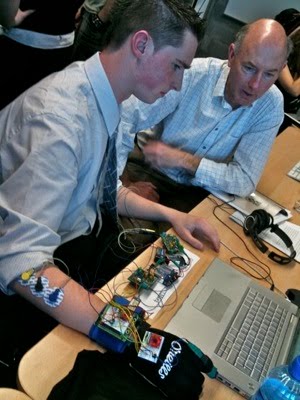
Conor Higgins demonstrating his Final Year Project to Malachy Eaton

Thinking back a few years, around 2005, when we finished writing the new curricula for DMD and MMPT, envisioning a new kind of graduate that could handle both aesthetics and technology, science and art, working and living in a computer-augmented world, it is just amazing how this year’s students have made our digital dreams come true. Initially, when we proposed the new courses, there was quite a lot of resistance to the radical change we suggested, while we had a strong belief in the necessity for changing the profile of our future graduates. We knew, from talking to young people looking for something interesting and relevant to study, that we needed a multidisciplinary approach. We also knew from our contacts with industry that they had difficulties finding graduates with a more creative and all-rounded profile. Last but not least, we know that students had to be introduced to what research is ideally already from their first year at university. When the new programmes had been approved and more than twice the number of students we had anticipated arrived, the hard work started – both for the students and for faculty. It feels like a real reward for all the laborious hours we have invested and all the money it required to modify laboratories, lecture rooms and to have new recording studios built, that we finally have a large group of excellent students, ready to take on the future.

>(sung to the melody of the Banana Boat Song by Harry Belafonte)
—–
…This version of the song can be heard as the Irish Builders and Developers are escaping (walking away) scot-free from their liabilities, as Cowen & D’Greens saving their banking friends, all at the Irish tax-payers future expense for many years to come….
——

Day-o, day-o
NAMA cometh and me wanna feck off
Day, me say day, me say day, me say day
Me say day, me say day-o
NAMA cometh and me wanna feck off

Work all night on a drink of stout
NAMA cometh and me wanna feck off
Stash some euros till de mornin’ come
NAMA cometh and me wanna feck off

Come, Mister Tee-Dee man, screw us with ba-NAMA
NAMA cometh and me wanna feck off
Come, Mister Tee-Dee man, screw us with ba-NAMA
NAMA cometh and me wanna feck off

Get six bill’, seven bill’, eight bill’ loan
NAMA cometh and me wanna feck off
Six foot, seven foot, eight foot bunch
NAMA cometh and me wanna feck off

Day, me say day-o
NAMA cometh and me wanna feck off
Day, me say day, me say day, me say day…
NAMA cometh and me wanna feck off

A beautiful bunch o’ ripe ba-NAMA
NAMA cometh and me wanna feck off
Hide the lively black econ’my
NAMA cometh and me wanna feck off

Get six bill’, seven bill’, eight bill’ loan
NAMA cometh and me wanna feck off
Six foot, seven foot, eight foot bunch
NAMA cometh and me wanna feck off

Day, me say day-o
NAMA cometh and me wanna feck off
Day, me say day, me say day, me say day…
NAMA cometh and me wanna feck off

Come, Mister Tee-Dee man, screw us with ba-NAMA
NAMA cometh and me wanna feck off
Come, Mister Tee-Dee man, screw us with ba-NAMA
NAMA cometh and me wanna feck off

Day-o, day-o
NAMA cometh and me wanna feck off
Day, me say day, me say day, me say day
Me say day, me say day-o
NAMA cometh and me wanna feck off
>Greedy businessmen (and women), many known as real-estate developers, in collaboration with the Irish banks drained the Irish economy of at least 90 billion euro over the last few years. That is the remaining balance when the economy now has ground to a halt and the developers say they cannot pay. The Irish government now wants the Irish people to pay them to pay the banks at least 90 billion to bail out the greedy developers.

Let’s think this through. There are outstanding “toxic” (i.e. cannot be repaid) loans of 90 billion. This amount was lent to the developers by the banks and profits have probably been moved off-shore, elsewhere, or just plainly spent on excessive consumption, by the aforementioned developers and bankers. As developers and bankers are now so unhappy, having to pay for themselves or go bankrupt or cease to be or disappear, they want us, you and me, to pay them 90 billion euro to allow them to continue their life styles and spend some quality time to try to figure out their next scheme to rob us of our savings (if any remaining), work (if any), life, pensions (if any), etc.

If we allow the defunct Irish government to proceed, we will all (every baby, teenager, adult, pensioner) be made to pay or owe 22,000 euro each, or, if the Central Statistics Office figures hold, about 62,000 euro per household.

Can you afford that?

Links: National Assets Management Agency (NAMA)

>The 18th of April 2009, the Softday Bacterial Ensemble performed the live music and multimedia Nobody Leaves ’till the Daphnia Sing. The performance with both humans and Daphnia Magna was a once off, but the INFECTIOUS exhibition and our installation with the Daphnia runs until the 17th of July 2009.

http://vimeo.com/moogaloop.swf?clip_id=4357140&server=vimeo.com&show_title=1&show_byline=0&show_portrait=0&color=00ADEF&fullscreen=1