Skip navigation

During the Sounding Object project, we researched and developed new approaches for sound on computers, responsive to physical interaction and easily matched to physical objects. One of the demos was the Vodhran, a virtual Irish Bodhran drum. The performers gestures are tracked using a Polhemus Fastrak 6-DOF electromagnetic tracker in realtime and the sound synthesized in real-time by our sound object models.


This summer, I’m planning to make another version of this, probably the Hodhran – a Hyper-bodhran, using a real bodhran, parts of a Wii controller, an Arduino and a few sensors (such as force sensitive resistors and bend sensors).

In the mid-1960’s, I first heard the sound of a synthesizer. When Wendy Carlos‘ album Switched on Bach was released in 1968 I was totally convinced that electronic instruments was the future. As I couldn’t afford to buy a real Moog, I spent a few years studying electronic engineering and telecoms to enable me to build my own, that I eventually used in my final year project in 1975. I think I’ve only one or two of the home-etched circuit boards left in some drawer. I had to disassemble the synth when I finished the final year project, as some parts were borrowed from physics labs, other parts designed and built by me (only recordings remain).

I was delighted today to find the Moog Foundation on the web. I fully agree with their vision that music, and in particular by using electronic instruments like the Moog-range, is an excellent way to get young people interested in art, science and technology. It is a very intuitive way to learn as you can start by exploring a few simple buttons and tweaking a few knobs – and immediately hear the result. The magic of this directness can then easily lead to a feeling of wonder about how it works. When you get onto that path of discovery, you can learn a lot about music, physics, electronics, maths, and a number of other things such as the importance of designing things so that they are suitable for human use. This is probably one of the most important aspects of Bob Moog‘s work. He worked together with musicians. While it is simple to get a knob to change the resonance frequency of a filter, the control curve (the mapping) has to feel natural to the musician (while it may sometimes be a difficult engineering problem to get the right non-linearity, especially when working with analog electronics).
So, here’s to Bob Moog, Wendy Carlos, and many others whose work and art I’ve enjoyed so much over the years, and still do. Let’s keep on designing, building, exploring and making.

I woke up this morning to blazing sunshine and blue skies. While having my morning cup of maté, I received an email that really mad me both sad and angry. Email is after all a very crude means of communication and while the sender probably didn’t intend to do damage, it did.
Later, while driving into Limerick city, despite the warm weather I closed the windows of my car and had a good 5 minute primal scream therapy while being patiently stuck in a queue. That somewhat helped. 20 minutes later, I tried to speak but my voice was almost gone! Now, several hours later, I think I actually managed to scar my vocal chords in my therapeutic attempt. So, anger and sadness is gone, but so is my voice for the time being.

Blue sky

Yesterday I borrowed a new gadget that we’ve received – a spherical mirror adapter for DSLR and Video cameras that allows you to take surround pictures.

The optics work well, but the UnWrap software has some bug when generating QuickTimeVR panoramas (at least the OSX version).

I went to see the last day of the exhibition in_flux hosted by Occupy Space in Limerick City. It has been really amazing to see how Ireland in recession suddenly starts to show more creativity than ever before.
Other countries have re-appropriated industrial spaces into social and artistic places for many years.
As far as I have seen, this rarely happened in Ireland. But now, we have newly built, sometimes not even finished buildings and structures that are unlikely to ever become what they were supposed to be, or finished, becoming great low-cost places for artistic exploration and social interaction.

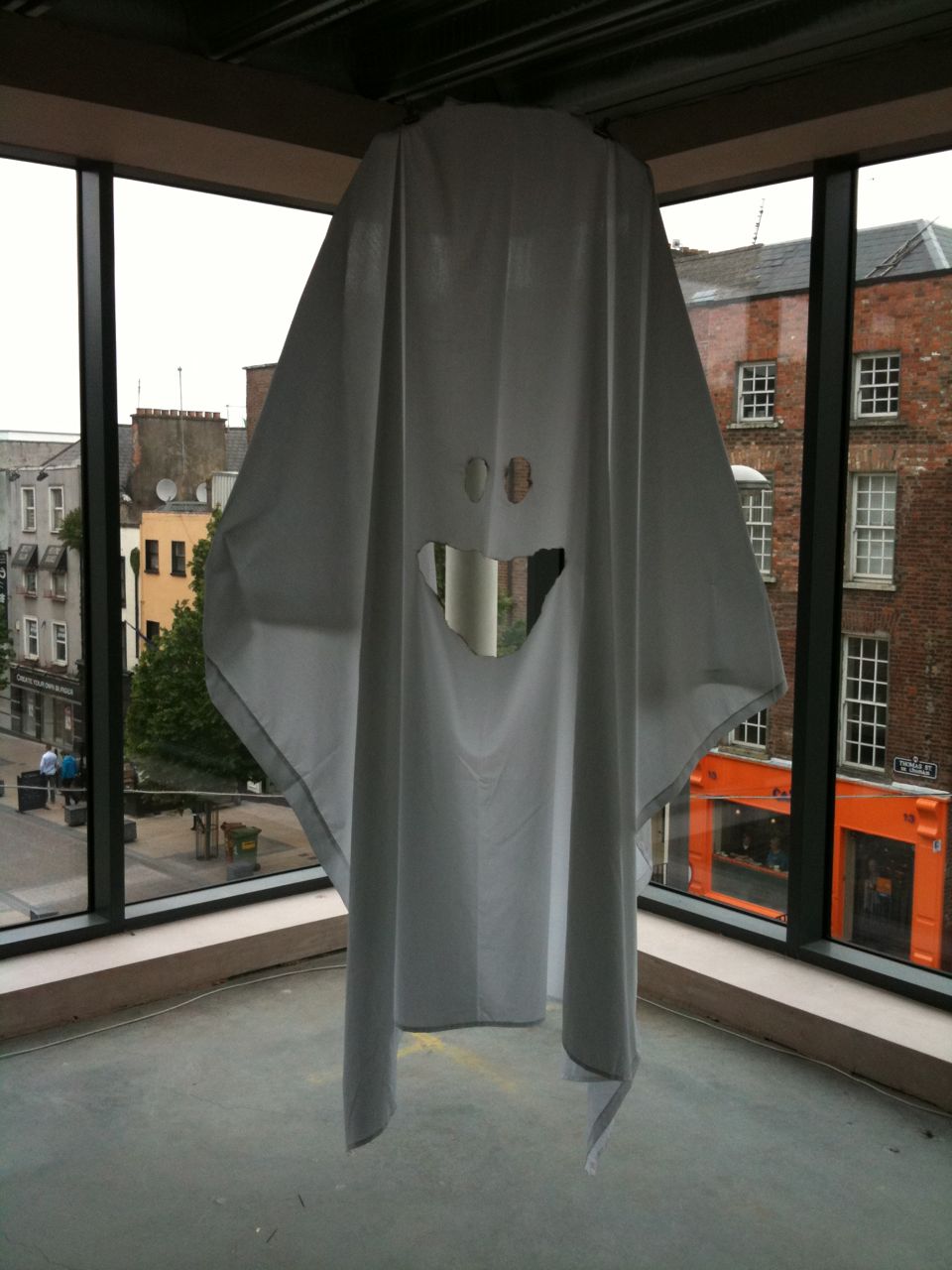
The Ghost of Catherine Street?


A taxonomy of crispy things

December 1997 - 16th of May 2011

He ran like a greyhound
He swam like a dolphin
He fulfilled our dreams,
walking across green hills
and Atlantic beaches
He had a heart of gold
We miss him.
R.I.P.

>

Charlie
December 1997 – 16th of May 2011

He ran like a greyhound
He swam like a dolphin
He fulfilled our dreams,
walking across green hills
and Atlantic beaches
He had a heart of gold
We miss him.
R.I.P.

I really enjoyed Trevor Wishart‘s Encounters in the Republic of Heaven at the launch of our new “label” the Digital Media Arts research Centre (DMARC) at the University of Limerick today. The 8-channel work sent my mind wandering, at times in synesthesia, and in general it was a very positive audio experience.

This summer I’m planning to develop a number of new sound object primitives that I can use both in Softday performances and in sonic interaction design. The basic idea is there are three fundamental classes:

  • Impact
  • Deformation
  • Friction

I’m sure that there will be many exceptions to these classes, but when I look at many of the pd-patches I’ve created over the past eight years, I think it may be possible to use this approach, where parameters define things like the material being deformed, the flow of the action (gesture), etc.

>It is that time again when Gombeen men (and women) will call to your front door trying to convince you to vote for them or somebody that they support in the General Election 2011. This time, it is more important than ever to get some real answers and real commitment from the politicians-to-be, as the previous governments have managed to crash the economy beyond repair ad betray us all.

There are several excellent initiatives by ordinary citizens to try to bring clarity to what, if anything, the politicians-to-be say they stand for. In any case, we have to make sure that the politicians-to-be are made fully aware of that they will be hired to for work us, not the other way around.
So, here are some links to what YOU can do to help uncover the truth about the politicians-to-be:

1. The National Interview
Get your camera, phone or whatever recording equipment you might have and ask the questions, below.
Upload your video to YouTube (or whatever site) and post your video link on Twitter with the tag #natint.

Links to good questions can be found here and here.

In addition to this, some good questions are:

  • Do you think our government should give away Irish gas and oil for nothing?
  • Do you think the debts of a private bank should be paid by the Irish people?
  • Do you think pensioners should pay extra taxes to pay for the cost of the banking collapse?
  • How did you vote on March 20th 2003? Did you support the invasion of Iraq through your support for the US military at Shannon airport – against the will of he majority of the Irish people? 
  • Can you explain why we have still not sorted out the health system so that sick people have access to appropriate medical treatment?
  • Why have you given away millions of euros of Irish people’s money to bail out the religious orders that have raped and abused Irish children?
  • Did you support wasting millions of euros of Irish people’s money on electronic voting machines that are completely useless and expert advice would have told you this if you looked for it prior to commissioning them?
  • How could you sell off Eircom and Aer Lingus – they belonged to the Irish people, not you?
  • How can you justify building private hospitals on public grounds instead of spending the time, energy, and resources improving the public hospitals and health system for all people not just the rich?
  • Why don’t we have proper public transport? 
  • Why have you wasted millions of Irish people’s money contesting the rights of children to have access to appropriate education and have sentenced countless autistic children to a life of isolation and misery?

2. The Tell Us Why campaign
Just as any other job applicant, get your politician-to-be fill out this form so that you can determine if they have any qualifications and who is the best suited for the job and make sure that we don’t get the wasters back.

3. And finally, remember to vote! It’s your life, your money, your family and your future that is at stake.